
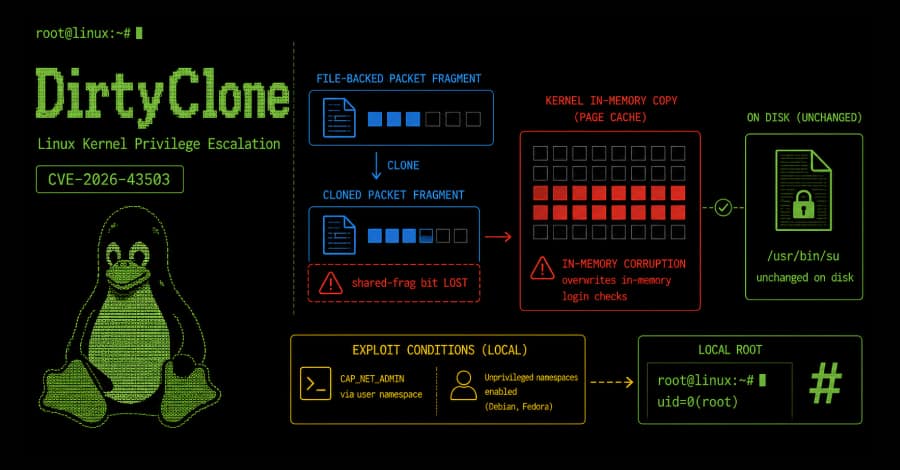
A newly disclosed Linux kernel vulnerability, known as DirtyClone, enables local attackers to escalate privileges to root by corrupting file-backed memory through network packet manipulation.
Tracked as CVE-2026-43503 (CVSS 8.8), the flaw is part of the broader DirtyFrag vulnerability family, a series of Linux kernel bugs affecting how file-backed memory is handled in networking operations.
Security researchers from JFrog Security Research published a working exploit demonstration on June 25, 2026, confirming real-world exploitability.
How the DirtyClone Vulnerability Works
The vulnerability originates in the Linux kernel’s handling of network packet cloning.
When the kernel processes certain network packets, internal helper functions fail to correctly preserve a critical safety flag that indicates whether memory is shared with a file on disk.
This missing flag allows file-backed memory to be treated incorrectly during packet processing, opening the door to memory corruption.
Attackers can exploit this behavior by:
- Loading a privileged binary such as
/usr/bin/suinto memory - Attaching its memory pages to a network packet
- Forcing the kernel to clone the packet
- Routing it through a controlled IPsec tunnel
During packet processing, the decryption stage can overwrite parts of the in-memory binary with attacker-controlled data. This can bypass authentication checks and result in instant root access.
Stealthy Exploitation Without File Modification
One of the most dangerous aspects of DirtyClone is that it does not modify files on disk.
Instead, all changes occur in the kernel’s page cache (in-memory copy) of the file.
This means:
- File integrity tools show no changes
- Logs do not capture the modification
- A reboot restores the original binary
- Attackers may already have root access before detection occurs
Because the attack is memory-resident only, traditional forensic tools may fail to detect the compromise.
Exploitation Requirements
To successfully exploit CVE-2026-43503, attackers require:
CAP_NET_ADMINcapability to configure a loopback IPsec tunnel- A system where unprivileged user namespaces are enabled
On distributions such as Debian and Fedora, unprivileged namespaces are enabled by default, allowing local users to obtain the required capability inside isolated environments.
However, Ubuntu 24.04 and later restricts namespace creation through AppArmor policies, blocking the default exploitation path.
Despite this, researchers note that page cache memory remains shared at the host level, meaning exploitation in other contexts may still impact the entire system.
Affected Systems and Environments
JFrog confirmed successful exploitation on systems running default configurations of:
- Debian
- Fedora
- Ubuntu
The vulnerability is particularly relevant to multi-user and multi-tenant environments, including:
- Cloud servers
- CI/CD build systems
- Container hosts
- Kubernetes clusters
- Shared research or development machines
Any environment that allows untrusted users to create namespaces is considered at higher risk.
DirtyClone Is Part of a Larger Vulnerability Pattern
DirtyClone is the fourth major Linux privilege escalation in a rapidly evolving class of kernel bugs that exploit similar weaknesses in memory and packet handling.
Related Vulnerabilities
- Copy Fail (CVE-2026-31431) – Exploited page-cache writes via the
algif_aeadmodule - DirtyFrag (CVE-2026-43284, CVE-2026-43500) – Used IPsec ESP and RxRPC paths to create write primitives
- Fragnesia (CVE-2026-46300) – Bypassed earlier fixes via a flag-handling flaw in
skb_try_coalesce()
Each vulnerability closed one attack path while leaving others exposed, demonstrating how difficult it is to fully secure Linux kernel fragment-handling logic.
DirtyClone specifically targets the __pskb_copy_fclone() function, with additional risk in skb_shift() and related fragment transfer helpers.
Root Cause: A Broken Memory Handling Contract
At the core of these vulnerabilities is not a single coding mistake, but a systemic design issue.
The Linux kernel uses zero-copy networking, which allows file-backed memory to be reused as packet data for performance optimization.
However, every function that moves or clones packet fragments must correctly preserve a critical flag indicating shared memory ownership.
If this flag is lost at any point, the kernel may mistakenly treat shared memory as private, leading to arbitrary memory corruption.
DirtyClone and related bugs demonstrate that even a single missed flag in the processing chain can turn a performance optimization into a privilege escalation primitive.
Timeline of the Fix
The vulnerability patch was developed following research submitted by Hyunwoo Kim, who identified multiple remaining frag-handling weaknesses.
Key milestones include:
- May 16, 2026 – Broader patch submitted covering multiple frag-transfer helpers
- May 21, 2026 – Fix merged into mainline kernel (commit 48f6a5356a33)
- May 23, 2026 – Assigned CVE-2026-43503
- May 24, 2026 – Included in Linux v7.1-rc5
The fix has since been backported to stable and LTS kernel branches, with advisories released by major Linux distributors.
Mitigation and Recommendations
The most effective mitigation is to install the latest kernel updates provided by your Linux distribution.
If patching is not immediately possible:
You can reduce exposure using the following temporary measures:
1. Disable unprivileged user namespaces
- Debian / Ubuntu:
kernel.unprivileged_userns_clone=0
This significantly reduces exploitability but may impact containerized workloads.
2. Restrict IPsec-related kernel modules
Blocking the following modules may reduce attack surface:
- esp4
- esp6
- rxrpc
However, this may break IPsec functionality or related services and is not a complete fix.
Conclusion
DirtyClone highlights an ongoing and evolving class of Linux kernel vulnerabilities where memory optimization features intersect with packet processing logic.
Because these flaws are rooted in subtle flag-handling inconsistencies, new variants are likely to emerge as researchers continue analyzing fragment-handling code paths.
Security teams are strongly advised to:
- Apply kernel updates immediately
- Restrict namespace usage where possible
- Monitor systems for unusual network and memory activity
Until fully mitigated, CVE-2026-43503 represents a serious risk for any Linux system allowing local user access.
