
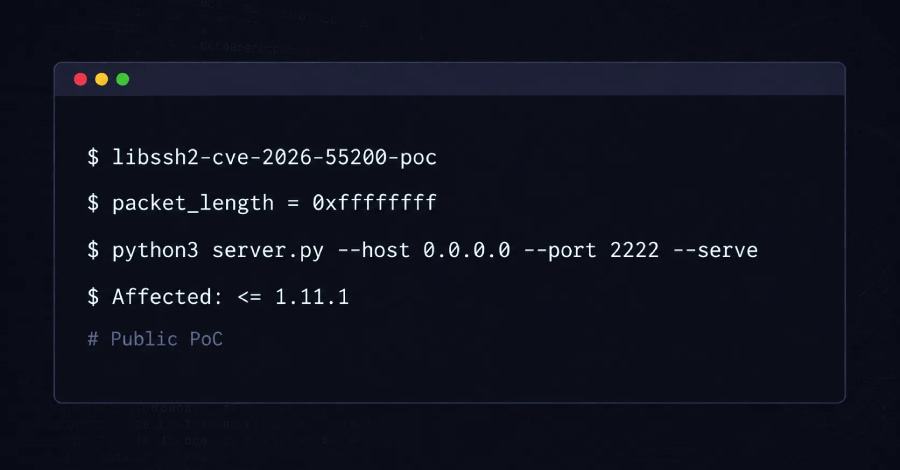
Public Proof-of-Concept Raises Urgency for Organizations Using libssh2
A newly disclosed security flaw in libssh2 has raised significant concerns after researchers released a public proof-of-concept (PoC) demonstrating how a malicious SSH server could compromise vulnerable clients.
Tracked as CVE-2026-55200, the vulnerability affects all libssh2 versions up to and including 1.11.1. The flaw has received a CVSS 4.0 score of 9.2, highlighting its critical severity and potential for remote code execution.
Unlike traditional SSH vulnerabilities that target servers, this issue impacts SSH clients that rely on libssh2, a widely used open-source library embedded in numerous software applications.
Widespread Impact Across Multiple Applications
libssh2 is commonly integrated into many popular applications and services, including:
- cURL
- Git
- PHP
- Backup software
- Firmware update tools
- Network appliances
- Embedded systems
Because many vendors statically link libssh2 into their software, simply updating the operating system may not remove the vulnerable library. As a result, organizations may unknowingly continue running affected versions.
How the Vulnerability Works
The flaw exists within the ssh2_transport_read() function responsible for processing incoming SSH packets during the connection handshake.
Researchers found that the function improperly validates the packet_length value supplied by the remote SSH server. While it rejects extremely small values, it fails to enforce a maximum packet size.
An attacker can supply an oversized packet length, causing an integer overflow during memory allocation. The library allocates a much smaller buffer than required before attempting to copy the full packet into memory.
This results in an out-of-bounds heap write, a classic memory corruption vulnerability that attackers may leverage to execute arbitrary code on the client system.
The vulnerability has been classified under CWE-680 (Integer Overflow to Buffer Overflow).
Similar Vulnerability Previously Affected libssh2
Interestingly, this is not the first time libssh2 has faced this type of issue.
Back in 2019, developers fixed CVE-2019-3855, another integer overflow vulnerability within the same transport parsing code that also allowed malicious SSH servers to execute code on connecting clients.
The recurrence of a nearly identical bug highlights the challenges of securing complex protocol parsing routines.
Public PoC Now Available
Security researcher Tristan Madani reported the vulnerability, and developers merged a patch into the project’s main source repository on June 12 through pull request #2052.
The vulnerability was officially assigned CVE-2026-55200 on June 17.
Shortly afterward, a public proof-of-concept appeared in the GitHub repository “exploitarium.” The available code demonstrates a controlled local remote code execution (RCE) test harness and an SSH trigger scaffold.
While it is not a fully weaponized exploit capable of compromising arbitrary systems, security experts warn that attackers could build more reliable exploits depending on:
- Target application design
- Memory allocator behavior
- Compiler security mitigations
- How software integrates libssh2
At present, there are no confirmed reports of active exploitation, and CISA has not observed the vulnerability being exploited in the wild.
No Official Release Yet, But Patches Are Available
Although an official libssh2 release containing the fix has not yet been published, the corrective patch has already been merged into the main development branch.
Several Linux distributions have begun backporting the fix into their packages. For example, Debian has already incorporated the patch into its testing branch.
Healthcare cybersecurity authorities, including NHS England Digital, have also advised organizations to update affected systems as soon as patched versions become available.
Recommended Mitigation Steps
Organizations using libssh2 should take immediate action by:
- Identifying all applications that include libssh2, including statically linked copies.
- Updating to builds containing commit 97acf3d or vendor backported fixes.
- Monitoring software vendor advisories for official patched releases.
- Restricting outbound SSH connections to trusted servers until updates are applied.
- Verifying SSH host keys before connecting to remote systems.
- Monitoring clients for unusual crashes or oversized packet activity.
Administrators should also patch two additional recently disclosed libssh2 vulnerabilities:
- CVE-2026-55199 (CVSS 8.2): Denial-of-Service vulnerability causing CPU exhaustion.
- CVE-2025-15661 (CVSS 8.3): SFTP heap over-read vulnerability.
Final Thoughts
CVE-2026-55200 is a serious client-side vulnerability affecting one of the most widely deployed SSH libraries in the software ecosystem. Since libssh2 is bundled into countless applications and embedded devices, many organizations may have vulnerable copies they are unaware of.
While no real-world attacks have been confirmed, the publication of a public proof-of-concept significantly increases the urgency to identify vulnerable systems and deploy available patches before attackers develop reliable exploitation techniques.
