
5 min read
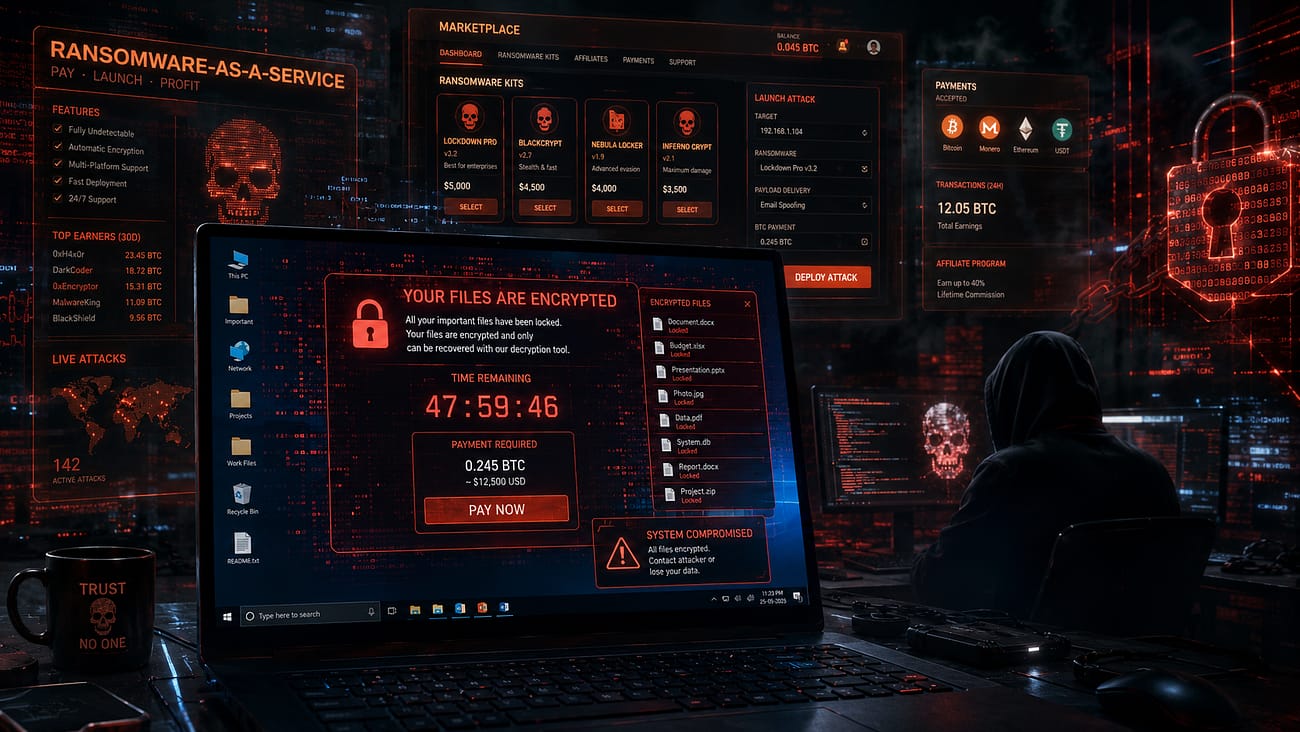
A few years ago, launching a ransomware attack required serious technical expertise – knowledge of malware development, network infiltration, encryption algorithms, and enough patience to assemble a complex operation from scratch. That era is over. Welcome to the age of Ransomware-as-a-Service, where anyone with bad intentions can rent a fully functioning cyberattack platform and deploy it against you before lunch.
“In 2025, ransomware victims surged 58% year-over-year. By Q1 2026, researchers tracked 2,318 ransomware incidents across 70+ active criminal groups and many of them don’t even write their own code.”
What Exactly Is Ransomware-as-a-Service?
Think of it like a subscription service — except instead of streaming movies, you’re renting the infrastructure for a cyberattack. Ransomware-as-a-Service (RaaS) platforms operate like legitimate SaaS businesses: there’s a dashboard, customer support, even affiliate programs. A criminal organization builds and maintains the ransomware tools. Affiliates — anyone who wants in — pay a fee or agree to profit-sharing, then use those tools to attack victims.
The barrier to entry is almost nonexistent. You don’t need to know how to code. You don’t need to understand network security. You just need access to the platform, a target, and a way to deliver the initial attack — usually a phishing email, a malicious download, or an exploit targeting an unpatched vulnerability on a Windows machine.
The Shift from Encryption to Pure Extortion
Here’s where 2026 ransomware gets even more alarming. Traditional ransomware worked by encrypting your files and demanding payment to unlock them. Modern ransomware groups are skipping the encryption step entirely. Instead, they steal your data and threaten to publish it publicly unless you pay.
No encryption means no warning. No locked screen. No obvious sign anything has happened. By the time you realize you’ve been hit, your files — your photos, your financial records, your business documents — are already in someone else’s hands. This makes traditional backup strategies less effective than they used to be. Even if you have a perfect backup of your data, you still face the threat of your stolen data being leaked or sold.
Who’s Actually Behind These Attacks?
One of the most unsettling things about the RaaS ecosystem is the diversity of people running it. We’re not talking exclusively about sophisticated nation-state hackers. We’re talking about people with minimal technical skills who found a criminal marketplace and decided to participate. The platforms handle the complexity. The affiliates just handle targeting and delivery.
In Q1 2026, researchers identified over 70 active ransomware groups operating across the globe. Some are large, organized criminal enterprises. Others are small, opportunistic operations running on rented tools. The fragmentation of the ecosystem makes it harder to shut down — take out one group, and ten more have already taken their place.
How Windows Users Are Specifically Targeted
Windows machines are the primary target of RaaS attacks for one simple reason: volume. With Windows still commanding the majority of the global desktop market, attacking Windows is simply more efficient. Ransomware groups optimize their tools for Windows file systems, Windows credential stores, and Windows network protocols.
Machines running Windows 10 without active security updates are particularly attractive targets. They’re functional, often connected to home networks or small business infrastructure, and frequently running outdated software with known vulnerabilities — exactly the kind of gaps RaaS affiliates are trained to exploit.
How Actipace Stops Ransomware Before It Starts
The most effective way to fight ransomware isn’t to recover from it — it’s to stop it from landing in the first place. Actipace’s anti-ransomware layer monitors your Windows system in real time, watching for the behavioral signatures of ransomware activity: rapid file access, unauthorized encryption attempts, unusual network outbound connections, and attempts to disable system restore points.
When these behaviors are detected, Actipace doesn’t wait for confirmation. It isolates the threat instantly, before your first file is touched. In a world where ransomware groups can hand off access and begin operations in as little as 22 seconds, every moment of delay is a moment of exposure. Real-time protection isn’t a premium feature — it’s a necessity.
- Never click links in unexpected emails, even from senders you recognize — phishing is the #1 delivery method for RaaS attacks.
- Keep Windows and all installed software fully updated — patches close the doors affiliates walk through.
- Maintain offline or cloud backups of critical files — even if they can’t stop data theft, they limit operational damage.
- Use a real-time antivirus with dedicated anti-ransomware protection, not just basic malware scanning.
