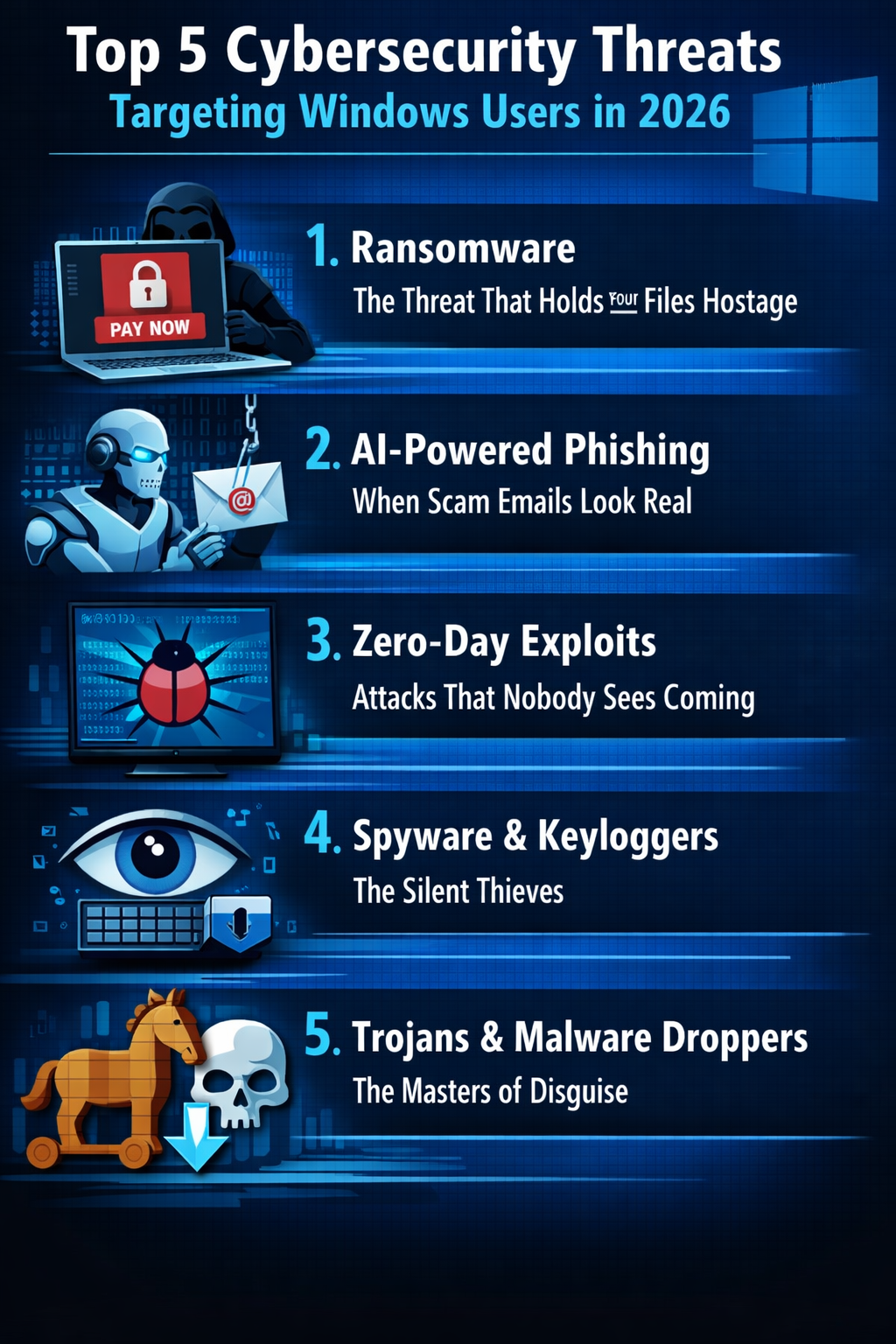
Hackers are getting smarter. Your protection needs to catch up. Here’s what’s actually targeting your PC right now – and what you can do about it.
By Team Actipace | 13 – 4 – 2026 | 8 min read | Cybersecurity
Let’s be honest – most people don’t think about cybersecurity until something goes wrong. A virus slows down the computer. A strange pop-up appears. Files suddenly get locked. And by then, the damage is already done.
Windows remains the most widely used operating system in the world – and that makes it the most targeted. In 2026, cybercriminals are not just smarter. They are faster, more automated, and increasingly powered by artificial intelligence. The threats that existed five years ago have evolved into something far more dangerous.
Whether you are a student, a working professional, a small business owner, or someone who just uses a PC at home – this blog is for you. No technical jargon. No scare tactics. Just a clear, honest breakdown of the top 5 cybersecurity threats targeting Windows users in 2026, and what actually works to stop them.
1. Ransomware: The Threat That Holds Your Files Hostage
Imagine waking up one morning, opening your laptop, and seeing a message that reads: “Your files have been encrypted. Pay $500 in Bitcoin within 48 hours or lose everything.” That is exactly what ransomware does – and in 2026, it has become the most financially damaging form of cybercrime in the world.
Ransomware sneaks onto your Windows PC through infected email attachments, malicious download links, or compromised websites. Once inside, it silently encrypts every file it can find – documents, photos, spreadsheets, work files – and locks you out completely. The attacker then demands a ransom in exchange for the decryption key.
What makes ransomware especially dangerous in 2026:
- AI-powered ransomware can now bypass traditional antivirus detection entirely
- Ransomware-as-a-Service (RaaS) means even non-technical criminals can launch attacks
- Average ransom demand for individuals has crossed $1,200 and businesses pay far more
- Paying the ransom does not guarantee you get your files back
The hard truth is that most traditional antivirus tools detect ransomware after encryption has already begun. By that point, your files are already compromised. What you need is a solution that stops the encryption process before it ever starts – not one that reacts to it after the damage is done.
| 💡 Quick Tip: Never open email attachments from unknown senders. Even a simple-looking PDF or Word file can carry ransomware. Always verify the sender before clicking. |
2. AI-Powered Phishing: When Scam Emails Look Real
A few years ago, you could spot a phishing email from a mile away. Poor grammar. Broken English. Suspicious sender addresses. But in 2026, that is no longer the case. Artificial intelligence has completely transformed phishing attacks and the results are terrifying.
Today’s AI-generated phishing emails are indistinguishable from legitimate ones. They mimic your bank, your employer, your favourite e-commerce platform, or even your colleagues – with perfect grammar, accurate branding, and personalised content pulled from your social media profiles. One click on a malicious link or attachment is all it takes to compromise your entire Windows system.
How AI phishing has evolved in 2026:
- AI writes contextually accurate, grammatically perfect phishing emails at scale
- Deepfake voice calls now accompany phishing email campaigns for added credibility
- Malicious attachments silently auto-download malware onto Windows the moment they are opened
- 97% of all cyber breaches globally still begin with a phishing attack
The most dangerous thing about phishing is that it targets human psychology, not just technology. Even careful, educated users fall for it. That is why your antivirus needs to catch threats at the file and URL level – before you even have a chance to make a mistake.
| 💡 Quick Tip: Before clicking any link in an email, hover over it to see the actual URL destination. If it looks even slightly off – don’t click. Go directly to the official website instead. |
3. Zero-Day Exploits: Attacks That Nobody Sees Coming
Here is a scary thought: what if there is a vulnerability in your Windows PC right now that even Microsoft doesn’t know about yet? That is exactly what a zero-day exploit targets – an unknown security flaw that has never been patched, never been documented, and for which no protection currently exists.
Zero-day exploits are the most sophisticated and dangerous category of cyberattack. They are used by nation-state hackers, organised cybercrime groups, and increasingly by well-funded criminal enterprises. On the dark web, a working zero-day exploit targeting Windows can sell for millions of dollars.
Why zero-day exploits are so hard to stop:
- Traditional signature-based antivirus has no record of the threat – so it cannot detect it
- Attacks can occur weeks or months before a patch is officially released
- Windows OS vulnerabilities are consistently among the most traded zero-days globally
- A single unpatched zero-day can compromise millions of devices simultaneously
Protecting against zero-day exploits requires something fundamentally different from traditional antivirus. Instead of looking for known threats, you need a solution that monitors behaviour detecting when something is acting suspiciously on your system, even if it has never been seen before.
| 💡 Quick Tip: Always keep your Windows operating system and all software up to date. Security patches close known vulnerabilities before attackers can exploit them. But for unknown vulnerabilities – you need behaviour-based protection. |
4. Spyware & Keyloggers: The Silent Thieves
Not every cyberattack announces itself. Some of the most damaging threats are the ones you never see. Spyware and keyloggers are designed to operate in complete silence – hiding in the background of your Windows PC, watching everything you do, and sending your most sensitive information to criminals halfway around the world.
A keylogger records every key you press – including your passwords, banking credentials, UPI PINs, and private messages. Spyware goes further, capturing screenshots, accessing your webcam, recording your microphone, and monitoring your browsing activity. You could be infected right now and have absolutely no idea.
The scale of the problem in 2026:
- Modern spyware is engineered to be completely invisible to users and basic security tools
- Remote Access Trojans (RATs) give hackers complete live control of your Windows PC
- Spyware can silently steal cryptocurrency wallets, banking OTPs, and saved passwords
- Spyware attacks on Indian Windows users increased by over 67% in 2025
What makes spyware and keyloggers particularly dangerous is that by the time you notice something is wrong – your bank account has been accessed, your passwords have been changed, your identity has been stolen – the criminal has long since disappeared. Prevention is everything here. Detection after the fact is often too late.
| 💡 Quick Tip: If your PC is suddenly slower than usual, your cursor moves on its own, or you notice apps opening without your input – these can be signs of active spyware. Run a full system scan immediately. |
5. Trojans & Malware Droppers: The Masters of Disguise
The name comes from the ancient Greek myth and the strategy is exactly the same. A Trojan horse looks completely harmless from the outside. A free movie player. A cracked version of paid software. A system cleaner promising to speed up your PC. You download it, you install it, and you unknowingly open a door that was never meant to be opened.
Malware droppers are an evolved version of this concept. They are specifically designed to silently install additional malware once they are on your Windows system – dropping ransomware, spyware, keyloggers, and banking trojans all at once. One infected file. Multiple simultaneous infections. Complete system compromise.
Why Trojans are so effective in 2026:
- Trojans are the most common delivery method for ransomware on Windows globally
- Cracked software, pirated games, and fake utility apps are primary Trojan delivery channels
- Multi-stage droppers are engineered specifically to evade basic antivirus detection
- A single dropper can install up to five different malware types simultaneously on one device
The golden rule: if something sounds too good to be free, it probably costs you more than money. Always download software from official, verified sources. And ensure your Windows security solution scans every file at the entry point before installation ever begins.
| 💡 Quick Tip: Never download software from unofficial websites or torrent sources. Even a tool that appears to work perfectly can be silently running malware in the background from the moment you install it. |
Quick Reference: 2026 Windows Threat Summary
Here is a quick overview of all five threats, their primary risk, and the key protection needed:
| No. | Threat | Primary Risk | Key Protection Needed |
| 1 | Ransomware | Files encrypted & held hostage | Pre-encryption blocking |
| 2 | AI Phishing | Identity & credential theft | Real-time URL & file scanning |
| 3 | Zero-Day Exploits | Unknown vulnerability attacks | Behaviour-based detection |
| 4 | Spyware & Keyloggers | Password & banking data theft | Background process monitoring |
| 5 | Trojans & Droppers | Multi-malware system infection | Entry-point file scanning |
Final Thoughts: Staying Safe in 2026
Cybersecurity is not just a concern for big corporations and IT departments anymore. It is personal. It is your photos. Your bank account. Your work documents. Your children’s data. Your identity.
The five threats we have covered – ransomware, AI phishing, zero-day exploits, spyware, and trojans are not hypothetical. They are active, evolving, and hitting Windows users across India and globally every single day. And the uncomfortable reality is that the old approach of “install basic antivirus and hope for the best” simply does not work anymore.
What works is being proactive. Understanding the threats before they reach you. Using a security solution that does not just detect threats – but prevents them at the source. And building habits that make you a harder target.
Because in cybersecurity, there is no second chance. Once your data is encrypted, stolen, or compromised – recovering it is expensive, stressful, and sometimes impossible. The time to protect yourself is before the attack not after.
About Actipace
Actipace is India’s first OPSWAT Gold Certified antivirus software, built exclusively for Windows. Developed by Actipace Private Limited, we are on a mission to redefine what cybersecurity truly means – moving it from reactive damage control to proactive, intelligent prevention.
What makes Actipace different from every other antivirus on the market is our world-first technology – a protection engine where malware simply cannot encrypt, delete, or damage your data. Not won’t. Cannot. The encryption process is stopped before it ever begins, which means there is no need for data recovery, no backup panic, and no ransom to pay.
We offer three protection plans to suit every need:
- Basic Defense: – Essential real-time malware and virus protection for everyday Windows users
- Internet Security: – Advanced protection including web threat scanning, phishing detection, and email security
- Total Security: – Complete, all-in-one protection covering every threat category including identity theft, spyware, and zero-day exploits
Made in India. Certified globally. Trusted to protect what matters most.
| Try Actipace Free for 30 Days No credit card required. Full protection from day one. www.actipace.com Made in India | OPSWAT Gold Certified |
