
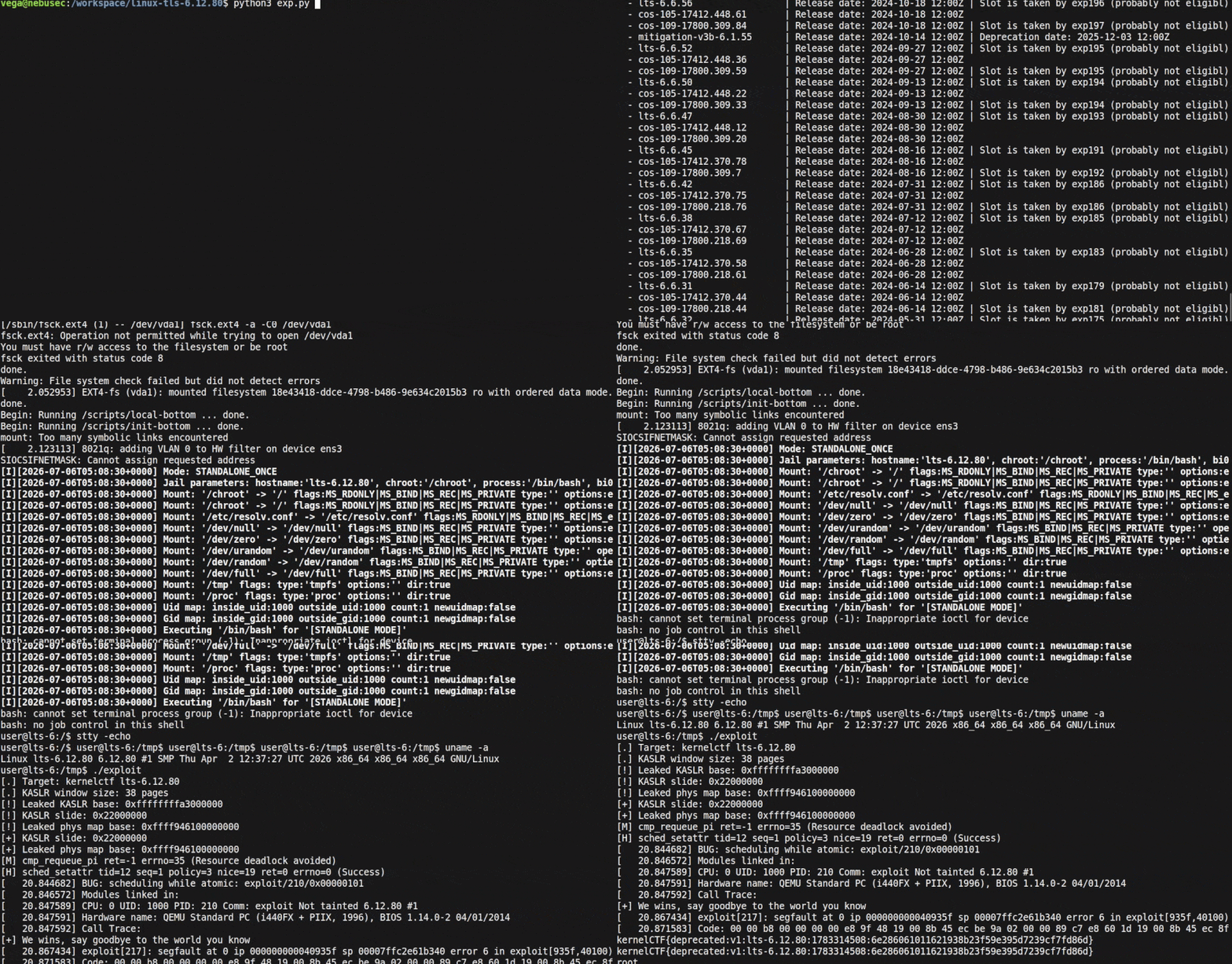
Security researchers have disclosed GhostLock (CVE-2026-43499), a Linux kernel vulnerability that has existed for approximately 15 years and could allow any authenticated local user to gain full root privileges on unpatched systems.
The flaw has been present in the Linux kernel since 2011 and affects nearly all mainstream Linux distributions. It requires no special privileges, unusual system configurations, or network access. Any logged-in user can potentially exploit the vulnerability using standard threading operations available to local applications.
Researchers successfully developed a proof-of-concept exploit that achieved a 97% success rate during testing and was also capable of escaping Linux containers. The discovery was recognized through Google’s kernelCTF bug bounty program.
Although there is currently no evidence that GhostLock is being actively exploited in the wild, proof-of-concept exploit code has been released publicly, making timely patching a critical priority.
How GhostLock Works
The vulnerability exists within the Linux kernel’s task scheduling and synchronization mechanisms, specifically in code responsible for preventing high-priority tasks from being blocked by lower-priority ones.
During a rare error condition involving lock operations, the kernel performs a cleanup routine at the wrong time. Instead of cleaning up the correct task, it mistakenly removes information associated with another process.
This error leaves the kernel with a stale memory reference, commonly known as a use-after-free vulnerability. Because the referenced memory has already been released and reused, an attacker can manipulate the kernel into executing malicious code with root-level privileges.
In testing, researchers were able to escalate privileges from a normal user account to full root access in approximately five seconds.
Affected Systems
The vulnerable code has been part of the Linux kernel since 2011 and was officially patched in April 2026. Nearly every Linux distribution using affected kernel versions is vulnerable until updated.
The vulnerability carries a CVSS score of 7.8 (High) because exploitation requires local access to the target system rather than remote code execution.
Patching Recommendations
Administrators should install the latest kernel updates provided by their Linux distribution rather than relying on the earliest available patches.
The initial security fix introduced an additional kernel crash issue tracked as CVE-2026-53166, requiring subsequent updates to fully stabilize the fix. Early patched kernels may therefore still require newer maintenance releases.
There is currently no complete workaround because the vulnerable functionality is part of normal kernel operations used by virtually every local process.
Organizations should verify that their installed kernel version matches the latest security advisory published by their Linux distribution instead of assuming automatic updates have already resolved the issue.
Mitigations Can Help—but They Are Not a Replacement
Certain kernel build options, including RANDOMIZE_KSTACK_OFFSET and STATIC_USERMODE_HELPER, can make exploitation more difficult by increasing attack complexity.
However, these features are only mitigations and do not eliminate the underlying vulnerability. Applying the official kernel patch remains the only effective solution.
Priority should be given to updating shared systems, cloud servers, container hosts, CI/CD runners, and multi-user environments where attackers may already have local access.
Part of a Growing Trend in Linux Kernel Vulnerabilities
GhostLock is one of several Linux privilege-escalation vulnerabilities disclosed during 2026.
Earlier this year, researchers revealed Bad Epoll (CVE-2026-46242), another local privilege-escalation flaw capable of granting root access. Unlike many similar vulnerabilities, Bad Epoll was also shown to affect Android devices and was successfully demonstrated through Google’s kernelCTF program.
Researchers note that both GhostLock and Bad Epoll affect long-standing kernel components that had received relatively little security scrutiny over the years until modern automated vulnerability discovery tools began analyzing them more extensively.
Another Linux vulnerability, Copy Fail (CVE-2026-31431), has already been added to the U.S. Cybersecurity and Infrastructure Security Agency’s Known Exploited Vulnerabilities (KEV) catalog after being observed in real-world attacks.
Browser Exploits Can Turn Local Bugs into Remote Compromises
Researchers also demonstrated that GhostLock can be chained with CVE-2026-10702, a Firefox vulnerability capable of escaping the browser sandbox.
By combining the browser exploit with GhostLock, attackers were able to achieve complete system compromise from a single malicious webpage on Firefox for Android.
This demonstrates why local privilege-escalation vulnerabilities remain highly dangerous. While they require an initial foothold on their own, pairing them with browser or application vulnerabilities can transform them into full remote compromise chains, significantly increasing their real-world impact.
