
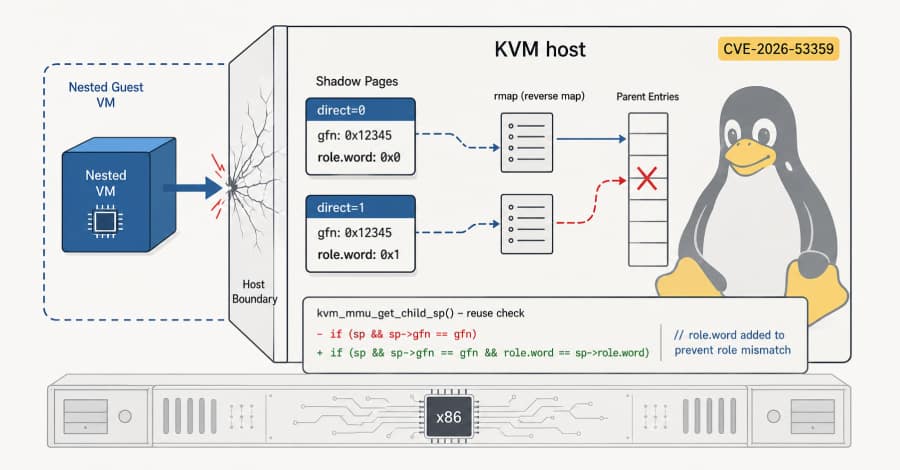
Security researchers have disclosed a critical vulnerability in the Linux Kernel-based Virtual Machine (KVM) hypervisor that allows attackers to escape from a guest virtual machine and compromise the host system.
The vulnerability, tracked as CVE-2026-53359 and dubbed Januscape, affects both Intel and AMD processors by exploiting a use-after-free flaw in KVM’s shadow memory management unit (MMU).
Although the publicly available proof-of-concept only crashes the host operating system, researchers say a separate private exploit can leverage the same vulnerability to achieve full code execution on the host.
A Long-Standing Vulnerability
The flaw was discovered by security researcher Hyunwoo Kim (@v4bel), who described Januscape as the first publicly known guest-to-host escape affecting both Intel and AMD KVM environments.
According to the researcher, the vulnerability remained undiscovered for nearly 16 years before being patched.
The exploit was also submitted as a zero-day entry to Google’s kvmCTF, a security research program that rewards researchers for discovering guest-to-host escape vulnerabilities in KVM.
How the Vulnerability Works
KVM maintains its own shadow page tables to mirror the memory layout of guest virtual machines.
The vulnerability exists because KVM identifies reusable shadow pages based solely on their memory address without verifying their actual page type.
Since different page types can share the same address while serving entirely different purposes, KVM may mistakenly reuse an incompatible page.
This mix-up corrupts the hypervisor’s internal memory tracking structures, resulting in unpredictable behavior.
From Host Crash to Full System Compromise
In most cases, the corrupted memory structures cause the Linux kernel to detect the inconsistency and immediately panic, crashing the host system.
The public proof-of-concept demonstrates this denial-of-service scenario, where a malicious virtual machine can bring down the physical host along with every other virtual machine running on it.
Under less common conditions, however, the vulnerability becomes significantly more dangerous.
If the freed shadow page is reused before cleanup occurs, the kernel may write data into memory that has already been reassigned.
Although attackers have limited control over the value being written, they can influence where the write occurs, creating an opportunity to escalate the attack into arbitrary code execution on the host.
While the triggering mechanism is identical on Intel and AMD processors, the final exploitation techniques differ between the two architectures.
Who Is at Risk?
The vulnerable code has existed since August 2010, when it was introduced in Linux kernel version 2.6.36.
The issue was finally resolved through a patch merged into the Linux kernel on June 19, 2026.
Successful exploitation requires:
- Root privileges inside the guest virtual machine
- Nested virtualization enabled on the host
Even environments that normally use Intel EPT or AMD NPT become vulnerable because nested virtualization forces KVM to fall back to the legacy shadow MMU, where the flaw resides.
Importantly, the attack targets the Linux kernel itself and does not require compromising QEMU or any userspace virtual machine manager.
Cloud Providers Face Elevated Risk
The vulnerability poses a significant threat to cloud environments that host untrusted virtual machines with nested virtualization enabled.
An attacker renting a single virtual machine could intentionally crash the physical host, disrupting all other customer workloads.
Researchers also claim their unreleased exploit achieves full root access on the host, potentially exposing every virtual machine running on the same server.
On certain Linux distributions where /dev/kvm is world-writable, the same vulnerability could also be abused for local privilege escalation.
Third Major Linux Kernel Discovery in Two Months
Januscape represents the third major Linux kernel vulnerability disclosed by the same researcher within a short period.
Previous discoveries include:
- Dirty Frag (CVE-2026-43284 / CVE-2026-43500) – A page-cache write vulnerability enabling reliable root access.
- ITScape (CVE-2026-46316) – The first publicly demonstrated guest-to-host escape targeting KVM on ARM64 systems.
Together, these findings highlight increasing research attention on virtualization security.
Patch Available
Linux maintainers have addressed the vulnerability by modifying the kvm_mmu_get_child_sp() function.
The patch ensures that KVM now verifies both the memory frame number and the shadow page role before reusing page structures, eliminating the unsafe behavior.
The fix has been included in the following stable kernel releases:
- Linux 7.1.3
- Linux 6.18.38
- Linux 6.12.95
- Linux 6.6.144
- Linux 6.1.177
- Linux 5.15.211
- Linux 5.10.260
System administrators should verify that their distributions have incorporated the security patch, as many vendors backport fixes without changing the kernel version number.
Temporary Mitigation
Organizations unable to apply updates immediately should disable nested virtualization using:
kvm_intel.nested=0kvm_amd.nested=0
Disabling nested virtualization removes the primary attack path for untrusted guest virtual machines.
Researchers also note that ARM64 systems are not affected by Januscape, although the previously disclosed ITScape vulnerability impacts KVM implementations on ARM64 separately.
Distribution Patch Status
Several Linux distributions have already begun rolling out updates, while others continue preparing patches.
- Debian has released fixes for testing and unstable branches, with updates for stable releases still pending.
- SUSE has marked the issue as important and is preparing kernel updates for supported enterprise releases.
- Ubuntu, Red Hat, AlmaLinux, Rocky Linux, and Oracle Linux are distributing or preparing vendor-specific backported fixes through their normal security channels.
Final Thoughts
Januscape demonstrates how a long-standing flaw in a core virtualization component can expose entire cloud infrastructures to compromise. Because the vulnerability allows guest virtual machines to crash or potentially take control of their host systems, organizations running x86 KVM environments—especially multi-tenant deployments with nested virtualization enabled—should prioritize patching immediately.
Administrators are also encouraged to verify vendor advisories rather than relying solely on kernel version numbers, as many Linux distributions backport security fixes without updating the upstream release version.
